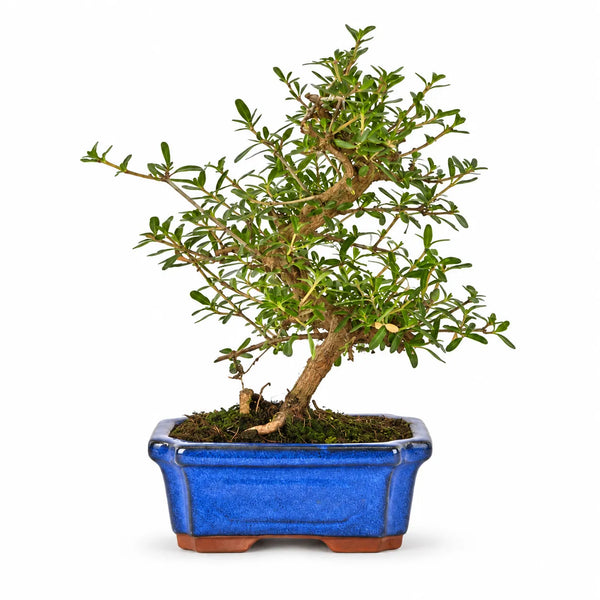
Coprosma sp. – The mirror plant, a bonsai with a radiant charm
A 7-year-old bonsai in a large size, native to New Zealand, suitable for growing both indoors and outdoors in frost-free areas. Coprosma, known as the Mirror Plant or Taupata, captivates with its oval, thick, brilliantly green leaves and its discreet display of small white flowers. A fast-growing species, ideal for anyone seeking a bonsai with a neat, lively appearance all year round.
Important notes: The bonsai's shape and dimensions are approximate (including the pot). The pot's color and shape may differ from the photographs. As living plants, their appearance changes with the seasons; the images are therefore purely illustrative and do not constitute a contractual commitment.
Main features
-
Habitat: Indoors / Outdoors (frost-free)
-
Leaf type: Evergreen
-
Flowers: Yes – small white flowers
-
Family: Rubiaceae
-
Approximate dimensions (width × depth × height): 22 × 20 × 28 cm
-
Pot size: Under 16 cm
Interesting facts
Coprosma is known around the world as the “mirror plant”: its leaves are so glossy that they look like real reflective surfaces. This detail makes it unique and immediately recognizable among the thousands of species cultivated as bonsai.
Position
Coprosma needs plenty of light to fully develop its characteristic glossy foliage. Indoors, place it near a window, no more than 50 cm from the glass. Outdoors, during favorable seasons, choose a partially shaded position, avoiding direct exposure to intense summer sun to protect the leaves from scorching.
Watering
Moderate: water when the first 1.5 cm of substrate begins to dry out. It does not tolerate waterlogging – using a well-draining substrate is essential.
Fertilization
From spring to mid-autumn, use the Hiryo Gold organic-mineral fertilizer or the fast-acting Nutribonsai fertilizer.
Repotting
Every 2-3 years, at the beginning of spring, just before vegetative growth resumes. After repotting, it is recommended to water with Mistral Bonsai's Vitabonsai revitalizer to speed up the plant's recovery.
Substrate
Terrabonsai – a special bonsai substrate that meets water and nutritional needs, promoting root development and overall vigor. Alternatively: 60% Kiryuzuna + 40% Akadama, which promotes growth but requires more frequent watering.
Pruning
Structural pruning should be carried out in late winter, before spring vegetative growth resumes.
Pinching
Throughout the growing season: pinch the outer new shoots to obtain a denser canopy, improve aeration and light penetration between the branches, and maintain the bonsai's shape.
Wiring
Due to its morphological characteristics, Coprosma generally does not require wiring. If necessary, the best time is shortly before spring vegetative growth resumes.