Pinus halepensis – The Aleppo pine, the soul of the Mediterranean
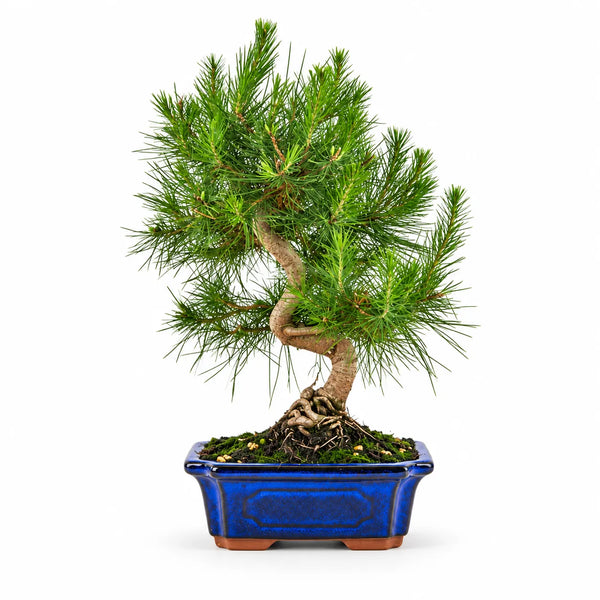
A majestic 9-year-old outdoor bonsai with an unmistakable personality. Pinus halepensis, known as the Aleppo pine, is one of the most iconic trees of the Mediterranean basin: evergreen, with characteristic slender needles and grayish bark that becomes mottled over time. It belongs to the conifer order – its fruits are the typical cones. Exceptionally resistant to drought and arid conditions, it is a bonsai with a powerful visual impact and profound naturalistic significance.
📌 Important notes: The bonsai’s shape and dimensions are approximate (including the pot). The color and shape of the pot may differ from the photographs. As living plants, their appearance changes with the seasons; the images are therefore purely illustrative and do not constitute a contractual obligation.
Main characteristics
-
Habitat: Outdoors – full sunlight all year round
-
Leaf type: Evergreen (needles)
-
Family: Pinaceae
-
Origin: Mediterranean basin
-
Approximate dimensions (width × depth × height): 29 × 31 × 43 cm
-
Pot dimensions: Under 16 cm
Interesting facts
Over the course of its evolution, Pinus halepensis has developed an extraordinary strategy: wildfires aid its reproduction, as the heat causes the cones to burst open and disperse the seeds. At the root level, it forms symbiotic relationships with specialized fungi – mycorrhizae – whose fungal hyphae greatly increase the plant’s ability to absorb minerals such as phosphorus from the soil.
Position
It must be kept outdoors, in full sunlight all year round. It is one of the bonsai species with the greatest need for sun exposure and is not suitable for indoor living.
Watering
Controlled and moderate. Excess water, especially in poorly draining substrates, is fatal to mycorrhizae – the precious symbiotic fungi that live in association with pine roots and enhance their nutrient absorption. Always allow the substrate to dry thoroughly between waterings.
Fertilization
In spring and autumn. Organic fertilizers are preferable, as they support and protect mycorrhizae.
Repotting
Every 3 years. After repotting, it is recommended to water with Mistral Bonsai’s Vitabonsai revitalizer to speed up the plant’s recovery.
Substrate
100% Kiryuzuna, or mixed with 50–70% Akadama. Alternatively, Mistral Bonsai’s Terrabonsai can also be used.
Pruning
During the colder months of the year. When pruning, always leave needles and buds on the branch: a branch completely devoid of vegetation tends to dry out.
Candle pinching
Carry out in spring, before the needles unfold (generally in March), working on the growing candles:
-
Strong candles: snap them off with your fingers, leaving only 1/3 of their length
-
Medium candles: snap them in half
-
Weak candles: remove only 1/3; if they are very weak, leave them untouched
Wiring
From October to March. Copper wire is preferable, as it is suited to the great flexibility of this species’ branches: the wire must remain in place for a long time to be effective.